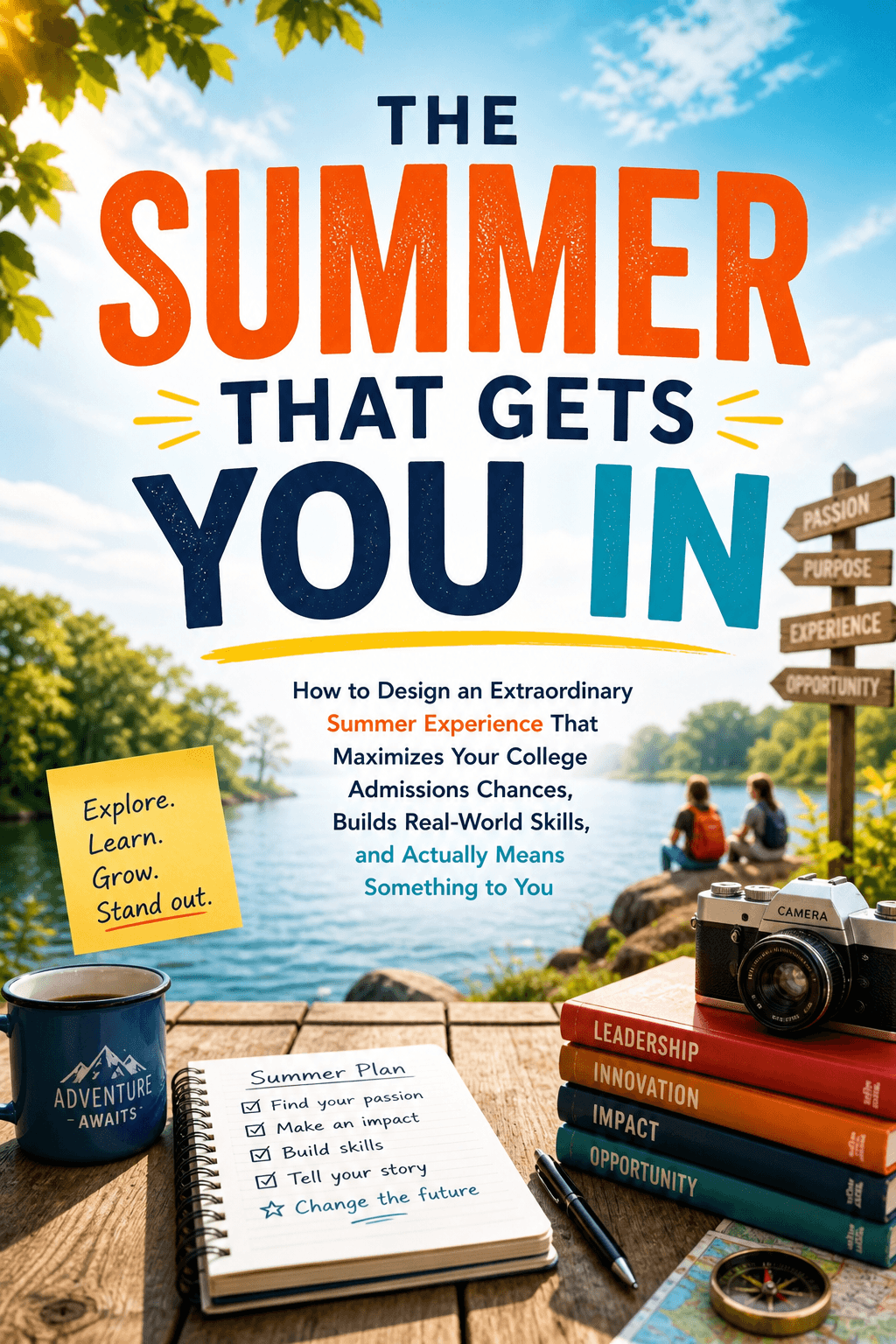
The Summer That Gets You In
How to help your high schooler design a summer that actually impresses admissions officers, builds real skills, and means something beyond the application.
The window is short. The students who plan now enter fall with a story. The ones who don't enter with a résumé.
Research-backed · Counselor-tested · Used by hundreds of families
Get Instant Access to The Summer That Gets You In
Complete guide + 8 appendices — PDF, instant download
One-time payment of $27 — no subscription
If you are reading this, you are probably the kind of parent who thinks ahead. You care about your student's future. You have watched them work hard, and you want to make sure that hard work translates into real opportunity when it counts most.
What I am about to share with you is not a list of expensive programs to enroll your child in. It is not a ranking of prestigious internships or a checklist of activities that are “guaranteed” to impress admissions officers.
What this is, is a research-backed, counselor-tested framework for helping your student design a summer that is genuinely theirs. One that colleges actually respond to. One that your student will look back on as meaningful, not just strategic.
The Summer Mistake That Plays Out in Thousands of Homes Every Spring
A parent asks their high schooler what they want to do this summer. The student shrugs. The parent starts Googling prestigious programs. The student gets enrolled in something that looks impressive on paper. And by August, everyone is exhausted, the student has a certificate they do not care about, and the college essay is still blank.
What Colleges Are Actually Looking For (And Why Most Students Miss It)
According to national surveys of admissions officers, extracurricular activities are rated as “considerably important” by only about six to seven percent of colleges overall. But that small percentage is concentrated almost entirely among the most selective institutions — the ones where your student is competing against thousands of equally qualified applicants.
At those schools, what separates one strong applicant from another is not the prestige of their activities. It is the quality of their engagement — evidence of what researchers and admissions professionals call positive character attributes: intellectual curiosity, genuine service to others, initiative, collaboration, and consistent engagement over time.
These qualities cannot be purchased. They cannot be faked. They can only be developed through real experience, pursued with real intention.
Independent research and self-directed projects are rated at least as highly as formal academic programs by admissions officers — sometimes higher.
A student who identifies a question, designs a project, and sees it through without external structure is demonstrating exactly the qualities that selective colleges most want to see.
Same Year. Completely Different Outcome.
No connective thread — every line reads like a checkbox.
A story. A spike. Something an admissions officer remembers.
This guide gives your student the framework to become Student B — in one summer.
Introducing: The Summer That Gets You In
A complete, research-backed guide for parents and students who want to approach the summer with real purpose. It draws on years of experience working with students through the college process, national data on what admissions officers actually value, and a proven framework for designing experiences that are both personally meaningful and genuinely compelling to colleges.
What You Will Learn
Not what they think they should value, and not what you think looks good — using a structured values clarification process that has helped hundreds of students find their direction.
The same model used by positive psychologists to measure human flourishing maps almost perfectly onto what colleges say they are looking for: Positive Emotion, Engagement, Relationships, Meaning, and Accomplishment.
Intellectual curiosity, service to others, leadership and initiative, collaboration, consistent engagement, and positive character attributes — and exactly how to help your student demonstrate each one.
And what self-directed alternatives can accomplish that no summer program can replicate — including how to get more from a free community project than most students get from a $10,000 program.
Instead of asking "what should my student do this summer," this framework asks "who does my student want to become?" That shift in question produces dramatically different and far more compelling answers.
Exactly what your student should be focusing on right now, whether they are entering ninth grade or heading into their senior year.
A simple, focused template that brings everything together into a clear, actionable roadmap your student can actually follow.
Because the best summer in the world means nothing if your student cannot articulate what it meant. This book shows them exactly how.
Is a Research Opportunity Worth It? Here's How to Actually Know.
Every spring, thousands of high schoolers send cold emails to university professors asking to join a research lab. Some hear back. Some even get a yes. And then — the question no one prepared them for: Is this the right opportunity? Should I keep emailing? Is what I have lined up actually good enough to matter on my application?
The Cold-Email Question
Most students send a few emails, hear nothing, and quietly stop. A smaller group keeps going — and some of them end up in labs. The difference is rarely talent. It is almost always persistence, and knowing when persistence turns into the right kind of signal.
There is a meaningful difference between a soft yes — “reach out again in a few weeks” — and a real commitment. Knowing how to read that difference, how long to keep going before pivoting, and how to follow up without becoming noise: that is a skill. Chapter Seventeen covers the exact framework for this, including cold-email templates, how to evaluate a professor's response (or non-response), and when you have enough momentum to stop searching and start building.
Is This Opportunity Good Enough?
This is the anxiety no one talks about. Your student has a response — maybe even a yes. But is it a good lab? A credible professor? A project that will actually produce something? Most families have no framework for answering that question, and so they default to either blind optimism or unnecessary anxiety.
Chapter Five — “Is My Summer Strong Enough?” — provides exactly that rubric. Applied to a research opportunity, the framework evaluates four things: depth of engagement (will your student actually do meaningful work, or will they be photocopying and filing?), potential for a tangible output (something verifiable, not just a line on a résumé), alignment with the student's narrative (does this connect to who they are and where they are going?), and the likelihood of producing something that admissions officers will actually notice. Most families are surprised by what they find when they apply it honestly.
The Publication Path
Let's say it directly: getting published as a high schooler is real, it is achievable for motivated students, and it matters. It is not a fantasy reserved for prodigies, and it does not require a Nobel laureate mentor or a fully-equipped university lab. What it requires is the right kind of project, the right documentation habits from day one, and the right strategy for what to do with the work once it exists.
The book covers the shortest credible path to publication — including what types of outputs actually count (it is not only peer-reviewed journal papers), how to document work as you go so that it becomes publishable rather than merely interesting, and how to position a research experience in essays and interviews even when formal publication is still in progress. A paper under review is a story. A published dataset is a signal. A tool used by real people is evidence. The book shows your student how to create and communicate all three.
What this section of the book answers
"My student emailed 12 professors and heard back from two. Should they keep going?"
→ Yes — and Chapter Seventeen tells you exactly how.
"We have an opportunity lined up — but how do we know if it's actually good?"
→ Chapter Five gives you the rubric. Most families are surprised by what they find.
"Is getting published as a high schooler realistic, and how do we make it happen?"
→ It's more achievable than you think — and the book shows you the shortest path.
“If your student is on the research track — or wants to be — this is the section of the book that will change how you think about the entire summer.”
Real Results from Real Families
“I wish I had found this two summers ago. We spent so much money on programs that looked impressive and did nothing for my daughter's essays. This book helped my son actually figure out what he cares about, and his application this year was completely different. His counselor said it was the most authentic she had seen from him.”
“As a parent, I kept pushing my daughter toward things I thought colleges wanted. This book helped me understand that I was making it worse. It also gave us a framework for talking about her summer that did not turn into an argument. That alone was worth it.”
“My son is not the kind of student who joins clubs and runs for office. He works part-time and spends his free time in online communities. This book helped us see that what he was already doing had real value, and showed us how to communicate it. He got into his first-choice school.”
The Pay-to-Play Myth
The summer program industry is built on an implicit promise: spend enough, and your student's application will be stronger. Programs affiliated with prestigious universities charge tens of thousands of dollars for a few weeks of structured experience. And families pay it, because the fear of falling behind is real.
But here is what the research actually shows. When admissions officers are asked to rate the value of different types of summer experiences, formal academic programs do not consistently outperform other types of experiences. In fact, independent research and self-directed projects often score higher, because they demonstrate initiative and intellectual curiosity in ways that structured programs simply cannot.
This book will show you exactly how to find those experiences, design them with intention, and help your student get more out of a free community project than most students get out of a $10,000 program.
Six Parts. Eight Appendices. Zero Vague Advice.
Chapter One: The Problem With Normal · Chapter Two: What Colleges Are Actually Looking For · Chapter Three: The Summer Question · Chapter Four: The Pay-to-Play Trap · Chapter Five: Is My Summer Strong Enough? A Framework for Evaluating Any Opportunity
Chapter Six: Introducing the PERMA Model · Chapter Seven: P Is for Positive Emotion · Chapter Eight: E Is for Engagement · Chapter Nine: R Is for Relationships · Chapter Ten: M Is for Meaning · Chapter Eleven: A Is for Accomplishment
Chapter Twelve: Step One, Know Your Values · Chapter Thirteen: Step Two, Learn What Colleges Value · Chapter Fourteen: Step Three, The Big Brainstorm · Chapter Fifteen: Step Four, Roles and Identities · Chapter Sixteen: Step Five, The Next Step
Chapter Seventeen: Cold-Emailing Professors and Pursuing Independent Research · Chapter Eighteen: The Online Student · Chapter Nineteen: Activities Outside School · Chapter Twenty: Grade by Grade Strategy · Chapter Twenty-One: Awards, Honors, and the Recognition Trap · Chapter Twenty-Two: The Elective Question
Chapter Twenty-Three: The Parent's Role · Chapter Twenty-Four: The Counselor's Toolkit · Chapter Twenty-Five: Building a School Culture Around Uncommon Experiences
Chapter Twenty-Six: The One-Page Summer Plan · Chapter Twenty-Seven: The Uncommon Essay · Chapter Twenty-Eight: The Uncommon Life
This Is Not Just About College
The qualities that make a student compelling to an admissions officer are also the qualities that make a person interesting, capable, and fulfilled. Intellectual curiosity. Genuine service. Initiative. Collaboration. Consistent engagement.
These are not just admissions assets. They are life skills of the highest order. And the summer experiences that develop them will serve your student far beyond any application deadline. The best admissions strategy and the best life strategy are the same strategy. This book helps your student pursue both at once.
Who This Book Is For
Less Than One Hour of a Private Counselor
The complete guide. No subscription. Instant access.
One-time payment — instant PDF download
🔒 30-day money-back guarantee — no questions asked. If it does not give you a clearer picture of what your student should be doing and why, simply reach out and we will make it right.
Your Child Has One Summer Coming Up
It will pass whether you plan it or not. The question is whether it will be a summer that adds something real to who they are — something they can write about with honesty, depth, and genuine conviction — or whether it will be another summer that looked fine on the surface and left nothing behind.
The framework is here. The exercises are here. The research is here. The only thing left is the decision to use it.
Get Instant Access for $27 →“After August, the story is written. The essays will draw from whatever exists. The interviews will reference whatever your student has actually done.”